
Top 6 Web Scraping APIs for AI Data Pipelines and Automation
AI is moving fast, but one problem keeps slowing everything down. Not models, not frameworks, but getting clean, usable data in the first place. Even the best model won’t do much if it’s working with outdated or messy inputs.
That’s why web scraping APIs matter more than ever. They’re no longer just a utility for pulling pages. They’ve become a core part of how AI systems collect and process information. Below are six tools that approach this problem in different ways, depending on how you build and scale your pipelines.
Why Web Scraping Is Critical for AI Pipelines
AI systems don’t run on models alone they run on data, and a lot of it. Training requires large, diverse datasets, while RAG setups depend on constantly updated information from the web to stay relevant.
But scraping today is not just about pulling raw HTML. The real task is turning unstructured web pages into clean, usable data. That step is where most pipelines either start working properly or completely fall apart.
Web scraping plays a central role in modern AI workflows:
- Collecting large-scale datasets for model training;
- Transforming web content into structured formats;
- Feeding RAG systems with fresh data;
- Extracting entities and relationships from unstructured text;
- Automating end-to-end data pipelines.
These specific tasks shape what you should look for in a scraping tool. Different pipelines need different capabilities.
Top 6 Web Scraping Tools
The market splits into three categories: API-first services, AI-native extractors, and full platform solutions. Each approach works better for different use cases and team sizes.
We’ve selected six tools that represent the best in each category: HasData, ScraperAPI, Apify, Firecrawl, Scrapfly, and Zyte. Let’s break down what each one does well.
1. HasData
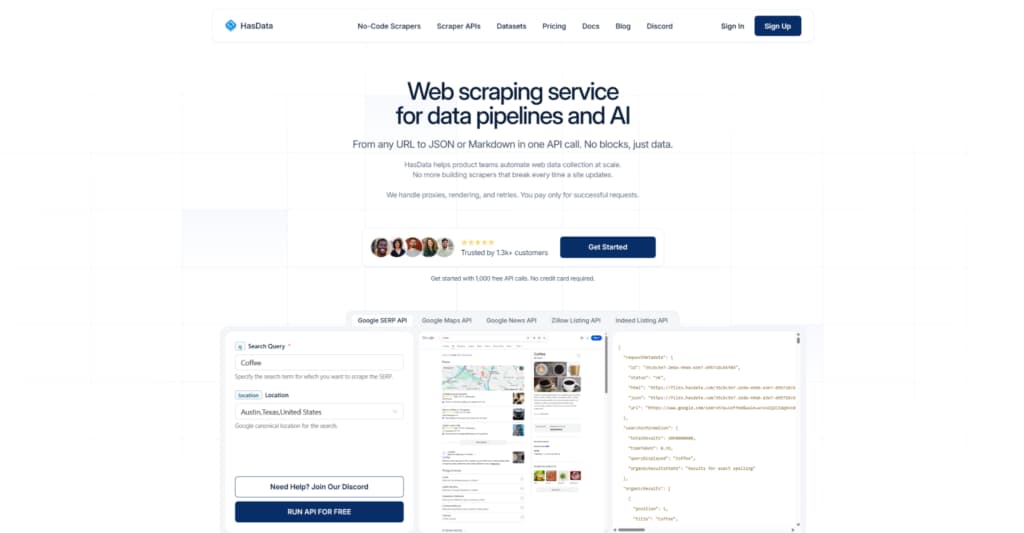
HasData is built as an AI-first web scraping API designed for LLM pipelines and automated data workflows. Instead of returning raw HTML, it focuses on extracting structured data that can be used immediately. This makes it especially useful for teams working with RAG systems or AI applications. The platform handles infrastructure challenges like proxies, rendering, and anti-bot protection. As a result, developers can focus on data usage rather than data collection.
AI-first extraction and LLM-ready data
Turning random websites into usable AI data is harder than it looks. HasData automates the entire extraction process, so you don’t need to write custom selectors for every site. The system handles the messy parts, rendering JavaScript, rotating proxies, and bypassing anti-bot measures so your pipeline stays running.
Key capabilities include:
- AI-based data extraction without custom selectors;
- LLM-ready Markdown and structured JSON output;
- Automatic proxy rotation and anti-bot bypass;
- JavaScript rendering for dynamic content;
- Scalable infrastructure without manual setup.
For AI pipelines and large-scale extraction jobs, this tool removes a lot of operational headaches.
2. ScraperAPI
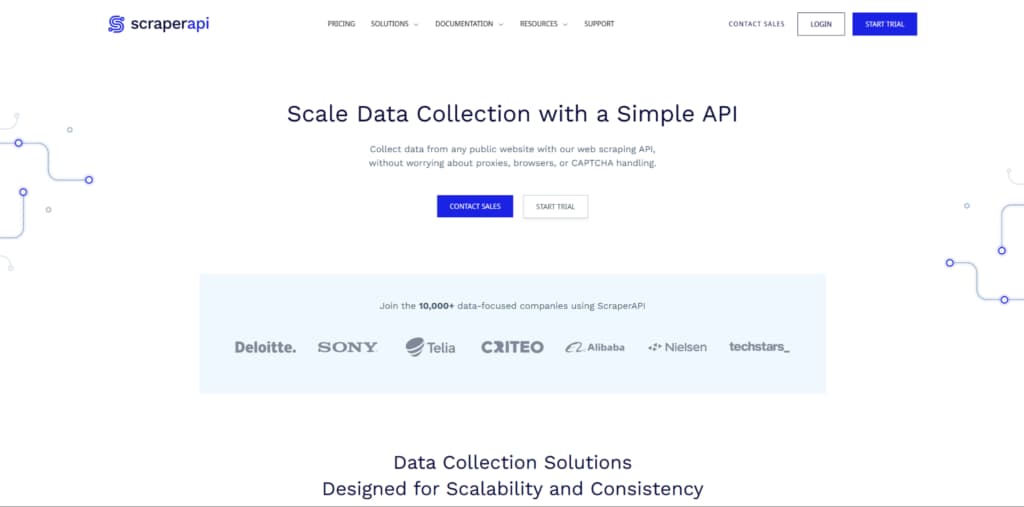
ScraperAPI is a straightforward web scraping API built for fast setup and ease of use. It removes the need to manage proxies, browsers, or anti-bot logic. You simply send a request and receive the page data. This simplicity makes it a popular choice for smaller teams and quick projects. It works well when you need reliable scraping without building infrastructure from scratch.
Simple and scalable API
Most scraping projects die on infrastructure complexity. ScraperAPI removes that barrier by handling everything server-side. You focus on what data you need, not on how to fetch it without getting blocked.
Key capabilities include:
- Automatic proxy rotation across multiple providers;
- Anti-bot handling and CAPTCHA bypass;
- Easy API integration with any programming language;
- Scalable request handling without rate limit anxiety;
- Minimal setup required to start scraping.
For entry-level and mid-market teams, this is a solid starting point that won’t require a dedicated engineering effort.
3. Apify
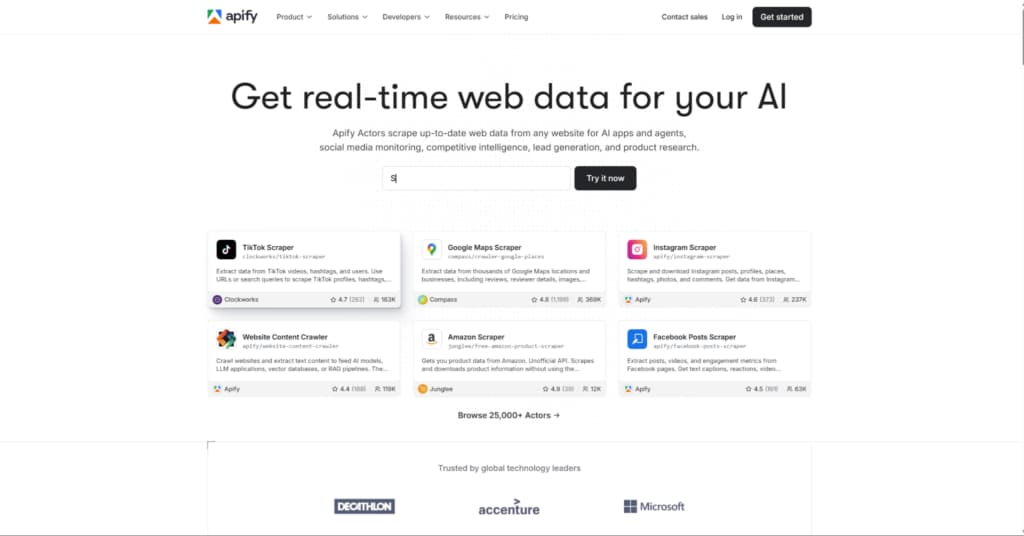
Apify is a full-featured platform for web scraping and automation, not just a simple API. It offers a large marketplace of ready-made scrapers that can be used out of the box. This allows teams to move quickly without building everything from scratch. The platform also supports custom workflows and integrations. It’s a good fit for projects that need flexibility and automation in one place.
Automation platform and ecosystem
The platform approach means you get more than just a scraper. You get orchestration, scheduling, data storage, and integration hooks. Teams can start fast by using what others have already built.
Key capabilities include:
- Ready-made scraping actors for hundreds of sites;
- Workflow automation with visual builders;
- Integration with APIs, databases, and cloud storage;
- Data extraction pipelines that run on a schedule;
- Cloud execution with no infrastructure to manage.
For rapid prototyping and teams that want to move fast without deep scraping expertise, Apify delivers.
4. Firecrawl
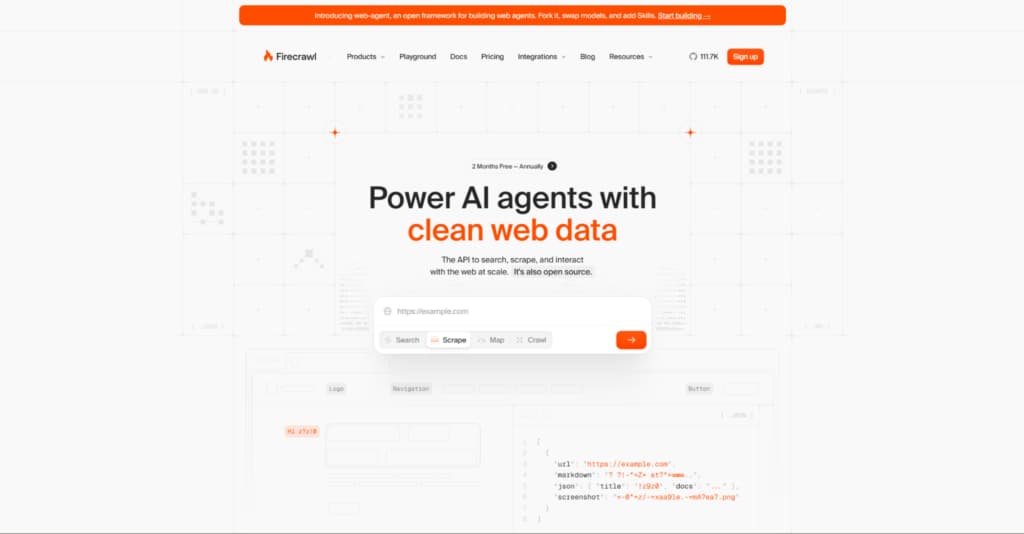
Firecrawl is designed specifically for AI and LLM-based workflows. Instead of returning raw page content, it converts websites into structured data ready for AI use. This makes it easier to plug directly into RAG systems and vector databases. The tool focuses on reducing preprocessing work for developers. It’s especially useful for teams building AI products that rely on fresh web data.
Built for AI agents
AI agents need clean, semantic data to work with. Firecrawl transforms entire websites into formats that LLMs understand natively. That means less preprocessing on your end and faster iteration on the AI side.
Key capabilities include:
- Structured content extraction optimized for LLMs;
- AI-ready outputs like Markdown and plain text;
- Native support for RAG workflows and chunking;
- Simplified data ingestion pipelines;
- Fast API access with low latency.
For teams building AI applications, this tool fits directly into the ingestion layer without extra glue code.
5. Scrapfly
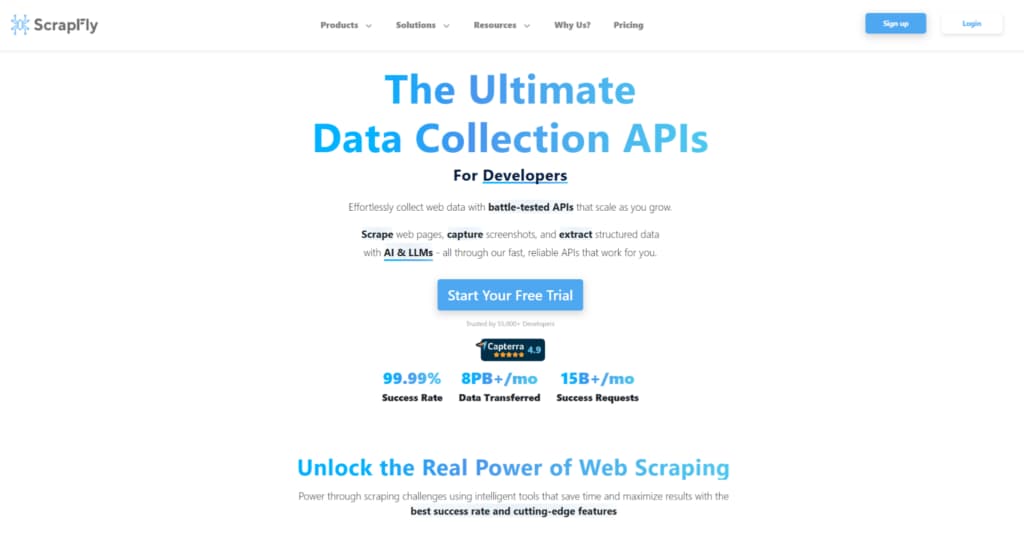
Scrapfly is a web scraping API focused on reliability and large-scale data collection. It is built to handle high request volumes without breaking under load. The platform manages proxies, anti-bot systems, and infrastructure automatically. This makes it suitable for projects where uptime and stability are critical. It works best for teams dealing with continuous or large-scale scraping tasks.
High-scale scraping infrastructure
Large-scale projects expose every weakness in your tooling. Scrapfly’s architecture is designed to absorb traffic spikes and bypass blocks automatically. You get consistent results even when target sites change their defenses.
Key capabilities include:
- High-volume request handling at scale;
- Anti-bot and proxy management built in;
- Structured data extraction from messy HTML;
- Reliable infrastructure with guaranteed uptime;
- Developer-friendly API with good documentation.
For high-scale projects where failure isn’t an option, Scrapfly is a strong contender.
6. Zyte
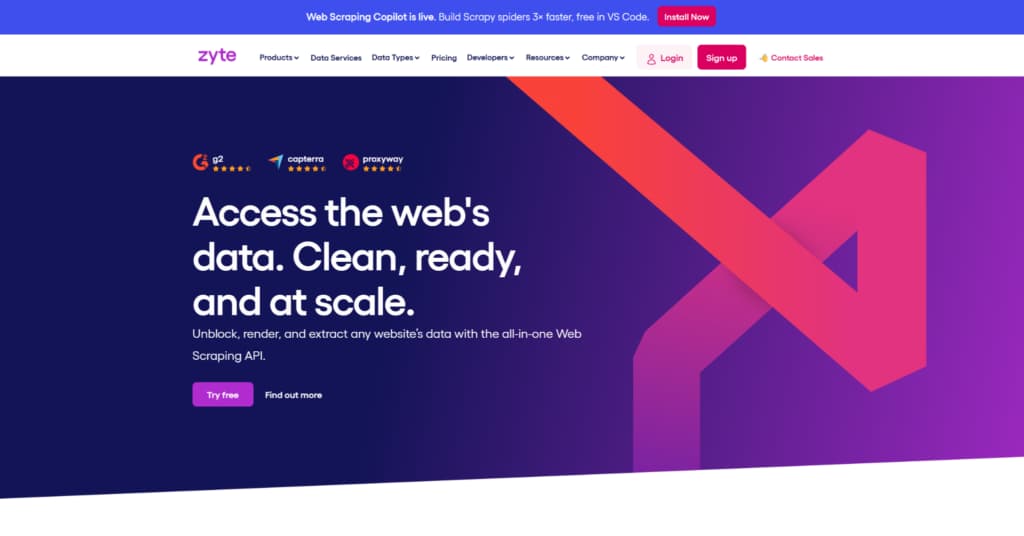
Zyte is a long-standing player in the web scraping space with a focus on managed data extraction. The platform goes beyond raw scraping by delivering structured, ready-to-use data. It uses AI to understand and extract useful information from websites. This reduces the need for custom parsing logic. Zyte is a strong option for companies that want a more hands-off approach to data collection.
Managed scraping and data services
Zyte focuses on delivering ready-to-use data rather than just the tools to fetch it. Their AI extraction layer turns raw HTML into structured fields automatically. Enterprise teams appreciate the managed service option where Zyte runs the entire pipeline.
Key capabilities include:
- AI-driven extraction that learns site structures;
- Managed scraping services with human oversight;
- Data delivery pipelines to your storage;
- Automation tools for monitoring and retries;
- Enterprise-grade solutions with SLAs.
For organizations that need stability, compliance, and predictable delivery, Zyte’s mature offering fits well.
How to Choose the Right Web Scraping Tool
Your AI pipeline’s requirements will dictate which tool makes sense. A simple RAG prototype has different needs than a production training data pipeline running millions of requests per day.
Don’t start with the tool. Start with your data volume, freshness needs, and output format. Then match those to the tool’s strengths.
When choosing a tool, focus on:
- Data output format and whether it supports LLM-ready structures;
- AI integration depth beyond basic API access;
- Scalability from prototype to production volumes;
- Anti-bot capabilities for your target sites;
- Developer experience and documentation quality.
The wrong tool will cost you weeks of engineering time. The right one makes your pipeline feel effortless.
Final Thoughts
Web scraping isn’t a side task anymore. It’s foundational to how AI systems get their data. Without reliable scraping, your model starves. Pick tools that match your scale and output needs, and you’ll spend less time fighting infrastructure and more time building actual AI. The quality and consistency of your data pipeline ultimately determine how well your entire AI system performs.