
Top 5 Crypto Payment Solutions for Business Use in 2026
Crypto payments have become a realistic option for businesses that operate across borders or deal with international clients. Traditional systems still come with delays, посредники, and higher fees, so companies start looking for alternatives that move money faster. Crypto looks like an obvious answer, but in practice, everything depends on how the payment gateway is set up. Not every provider solves the same problem, and some introduce new friction instead of removing it. That’s why the choice of platform matters more than it seems at first.
The real difference shows up when payments become part of daily operations. Things like settlement speed, conversion into fiat, approval rates, and integration complexity start to affect the workflow. Some tools are built for retail users, others for enterprise-level transactions. There are also platforms that focus on compliance or user onboarding instead of payment processing itself. Because of that, comparing them directly helps you understand which one actually fits your setup.
How These Crypto Payment Providers Were Selected
This list isn’t based on marketing claims or long feature checklists. The focus is on how these tools actually behave when used in real payment flows. Things like reliability, how easy they are to plug into an existing setup, and how smoothly payments move from crypto to fiat matter much more in practice. Each provider here takes a slightly different approach, so the comparison below shows where they make sense and where they can start to create friction.
1. Paybis
The platform positions itself as a reliable and responsive service, reflected in strong Trustpilot ratings and a focus on customer support that encourages repeat use.
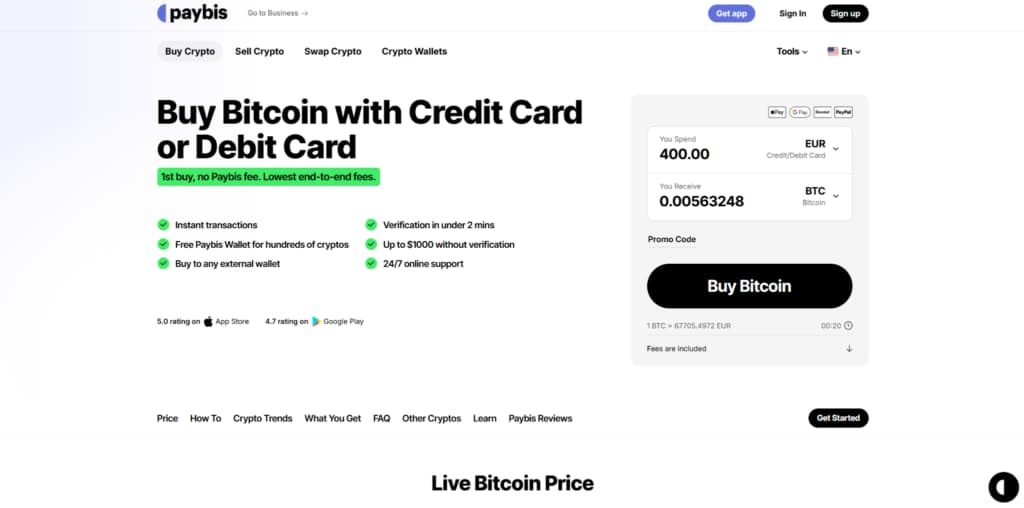
Paybis is mostly about getting things done without overcomplicating the process. People usually go for it when they just need to buy crypto quickly and don’t want to deal with a bunch of extra steps. It’s available across many regions, including most states in the United States, and feels more like a mass-market tool than something built for niche use cases. The onboarding isn’t heavy, and once you’re verified, transactions go through pretty fast without much friction.
The main strength of Paybis is how quickly transactions are processed. Buying crypto with a card is almost immediate for verified users, while new users can still complete the process within a short timeframe. In addition to purchases, the platform allows users to sell assets, store them in a built-in wallet, and access staking options. This makes it a closed-loop system for moving between fiat and crypto without relying on multiple services.
To understand where Paybis stands out, here’s what it offers in practice:
- Fast crypto purchases with minimal delay after verification;
- Support for card payments and multiple major cryptocurrencies;
- Built-in wallet and staking options for holding and managing assets;
- Global availability across a wide range of regions;
- Simple flow for converting between fiat and crypto.
Overall, Paybis works best as an entry point into crypto or for handling quick transactions. It’s not built as a full merchant gateway, but it does its job well when speed and simplicity are the priority.
Service scope:
| Feature | Details |
|---|---|
| Minimum purchase | $5 |
| Daily limit (verified) | $20,000 |
| Monthly limit (verified) | $50,000 |
| Smallest unit | 0.00000001 BTC (1 Satoshi) |
Weakness: The platform is optimized for retail buyers rather than merchant payment processing, with limited documentation around API integration or checkout flows for e-commerce businesses.
2. CoinGate
Built for businesses that need a crypto payment gateway they can actually rely on, CoinGate brings together regulatory clarity, broad asset support, and flexible settlement in one place.

CoinGate has been operating since 2014 and focuses on making crypto payments easier to work with in regulated environments. Being among the early providers aligned with MiCA standards in the EU, it’s often considered by companies that need compliance from the start. The platform supports Bitcoin along with a smaller set of other assets, and payments can be converted into euros or stablecoins almost immediately. This reduces the need to hold crypto and deal with price fluctuations after each transaction.
To see how CoinGate works in practice, it helps to look at what it provides:
- Immediate conversion of incoming payments into fiat or stablecoins;
- Support for common e-commerce integrations and custom API setups;
- Tools like payment buttons and email invoices for simpler workflows;
- Ability to process payouts and refunds directly in crypto.
Overall, CoinGate fits businesses that need a balance between compliance and usability. It’s not the most complex solution, but it covers the essentials without adding unnecessary friction.
Pricing and volume tiers:
| Plan | Fee | Notes |
|---|---|---|
| Standard | 1% | No monthly fees, pay-as-you-go |
| Enterprise | Custom | Value-based pricing for high-volume transactions, a dedicated account manager, and a branded checkout flow |
Weakness: No published transaction success rates or uptime metrics to validate reliability claims during network congestion periods.
3. BitPay
BitPay builds powerful, enterprise-grade tools for crypto acceptance and spending, pioneering blockchain payment technology to transform how businesses and people send, receive, and store money around the world.
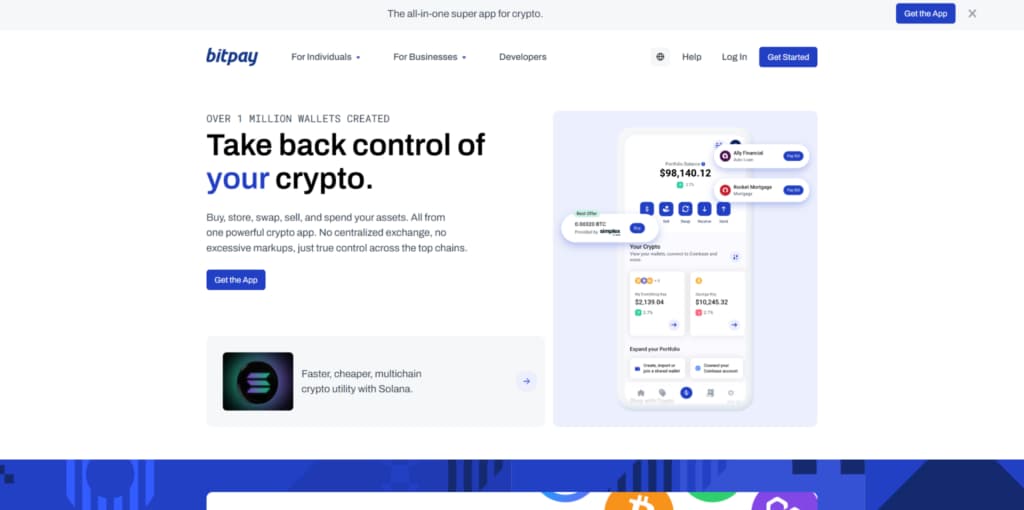
BitPay has been in the market since 2011, so it has had time to build out a more complete system. It is not only about accepting crypto payments. The platform also covers things like checkout and basic asset handling. It works for e-commerce, retail, and even donations, so it can fit different types of businesses. Pricing depends on how much you process, which means fees go down as volume grows instead of having to change plans.
What also stands out is the broader toolkit around payments. Businesses can buy and exchange crypto, store assets in self-custody wallets, and even use features like gift card purchases to convert crypto into spending power. For companies managing multiple streams of funds, the ability to separate wallets helps keep operations organized. It’s more of an all-in-one system than a simple gateway.
To understand how BitPay works in practice, here are the main things it brings to the table:
- Support for buying and handling a wide range of cryptocurrencies;
- Ability to exchange assets for treasury and liquidity management;
- Direct spending from the wallet without needing to move funds externally;
- Volume-based pricing that adjusts as transaction activity increases.
Overall, BitPay is suited for businesses that want more control over how crypto is handled beyond just accepting payments. It offers more depth than simpler tools, but that also means it may feel heavier for teams that only need a basic gateway.
Weakness: Pricing tiers and specific rate breakpoints are not publicly documented, requiring direct sales contact to model actual costs at your transaction volume.
4. Coinmama
Coinmama eliminates middlemen, hidden fees, and complicated jargon while offering transparency, security, and innovation with regulatory compliance and user education as core differentiators.
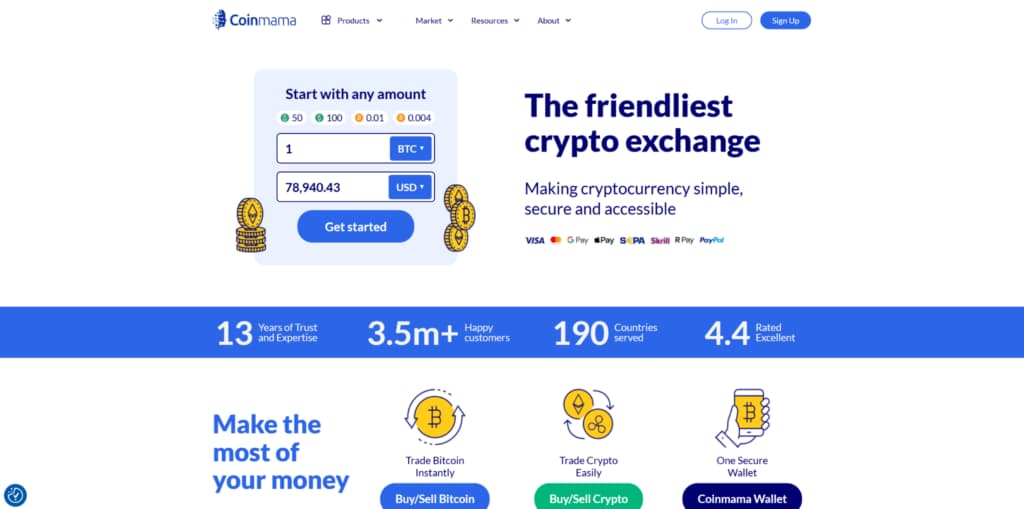
Coinmama is built around direct purchases rather than merchant processing. Instead of focusing on checkout flows or accepting crypto from customers, it helps users and businesses buy digital assets quickly using familiar payment methods. Founded in 2013, the platform supports major currencies and payment options like cards and bank transfers, making it accessible across a wide range of markets. The focus here is not on infrastructure, but on making crypto easy to acquire when needed.
To see where Coinmama fits in practice, it helps to look at what it actually offers:
- Direct purchase of Bitcoin and Ethereum using cards or bank transfers;
- Support for multiple fiat currencies across global markets;
- Fast delivery of crypto once payment and wallet details are confirmed;
- Wide geographic coverage for international operations;
- 24/7 customer support for resolving transaction issues.
In practice, Coinmama works best as a quick access point to crypto rather than a full payment solution. It’s useful for businesses that need speed and simplicity, but it doesn’t replace a dedicated gateway for handling incoming payments from customers.
Pros and cons:
| Strengths | Limitations |
|---|---|
| Fast execution | No published fee schedule for comparing costs |
| Doesn’t store credit/debit card details | Focused on buy-side; limited merchant tools |
Weakness: The platform is optimized for retail crypto purchases rather than merchant payment acceptance, making it less suitable for businesses needing checkout integrations or recurring billing.
5. MoonPay
With nearly 30 million customers and powering the infrastructure for nearly 500 companies across the decentralized economy, MoonPay is a key driver behind mainstream crypto adoption.

MoonPay grew fast because it keeps things simple. People can pay the same way they usually do, using a card, Apple Pay, or PayPal, without learning how crypto works first. There is no need to deal with wallets or extra steps at the start. For businesses, this often means fewer users drop off during onboarding. Since 2019, many consumer apps have picked it for this exact reason.
It also works across different regions, which makes it easier to scale. The platform meets basic regulatory requirements and does not force businesses to rebuild their setup for every new market. It is not only about buying crypto either. Users can send, receive, and hold assets in one place, which makes everyday use more practical. For companies working internationally, this helps keep operations simpler.
To understand how MoonPay fits into real workflows, it helps to look at what it actually enables:
- Buying crypto through familiar payment methods like cards, Apple Pay, PayPal, and Venmo;
- Selling crypto back into fiat without complex conversion steps;
- Managing stablecoins for more predictable financial operations;
- Handling payments through card-based processing flows;
- Supporting user-friendly onboarding for consumer applications.
In practice, MoonPay fits best when the goal is to keep the entry point easy for users. It reduces friction at the start, which is why many apps rely on it. At the same time, if a business needs more control or clearer pricing, it is worth checking the details before integrating.
Weakness: Fee structure is not transparently published, and actual costs vary by payment method and jurisdiction, making it difficult to model expenses before integration.
Quick Comparison of Crypto Payment Gateways
At a glance, many crypto payment gateways look quite similar, but the differences start to show once you dig a bit deeper. Some are built around compliance, others focus on scaling transactions, while a few prioritize ease of use above everything else. These differences affect how payments move, how quickly funds arrive, and how predictable the overall process feels in day-to-day use.
Here’s how the main options compare based on their positioning and typical use cases:
| Gateway | Best for | Founded | Notable specialty | Fee structure |
|---|---|---|---|---|
| CoinGate | EU compliance priority | 2014 | MiCA-licensed | 1% standard |
| BitPay | Enterprise infrastructure | 2011 | Tiered volume pricing | Volume-based |
| Coinmama | Direct fiat-to-crypto | 2013 | 190+ countries | Transparent flat |
| MoonPay | Mainstream adoption | 2019 | 30M+ customers | Card-friendly |
| Paybis | Instant retail purchases | 2014 | 24/7 support | Competitive retail |
If you look at the table, the differences are mostly about what each tool is trying to do. CoinGate is more about working cleanly in the EU with clear rules and simple fees. BitPay is built for bigger operations where volume matters. Coinmama is closer to a quick way to move from fiat into crypto across many countries. MoonPay focuses on making the first step easy for regular users. Paybis is more about speed and quick transactions without extra steps.
So it is not really about which one is better overall. Each of them fits a different situation. The choice depends on how your payments actually work and what you need from the system.
Final Thoughts
You only really see the differences between these tools once they’re part of your payment flow. On paper, they might look similar, but day-to-day use tells a different story. Things like how quickly funds settle, what happens when a payment fails, or how transparent the fees are start to matter a lot more than feature lists.
In practice, each provider fits a slightly different role. Some handle recurring payments more smoothly, while others are better for one-off transactions or bringing new users into crypto. There isn’t a single “best” option here.
It’s usually less about picking the top platform and more about not choosing the wrong one for how your business operates. Start by looking at how payments actually move through your system, then choose the gateway that matches that flow.