
Companies That Turn LMS Ideas Into Real Products
Modern LMS platforms do more than train employees. They manage institutional knowledge, automate workflows, and directly affect business performance. EdTech keeps growing. Corporate training budgets keep expanding. According to our data, companies now expect learning systems to drive revenue, not just track compliance.
Off-the-shelf LMS solutions rarely solve real business problems. Your processes don’t match their workflows. Your integrations break their assumptions. Many businesses discover this after sinking money into platforms that fight them at every turn. Below we list teams that actually turn LMS concepts into working products.
What Makes LMS Development More Complex Than It Looks
An LMS includes far more than a pretty interface. You need user roles across multiple departments. You need analytics that answer real questions. You need HR system integrations, content management, and security that doesn’t crack under pressure. Architecture mistakes break systems when user counts climb.
Companies routinely underestimate LMS complexity. They think “course platform” and stop thinking. Then growth hits and everything falls apart. According to our analysts, this pattern repeats across industries. The main challenges companies face when building LMS platforms include:
- User role management across departments and regions;
- Integration with HR systems, CRMs, and internal tools;
- Content delivery at scale with stable performance;
- Tracking certifications, progress, and compliance;
- Data analytics connected to business outcomes.
These challenges demand experienced development teams. No shortcut exists.
1. Geniusee
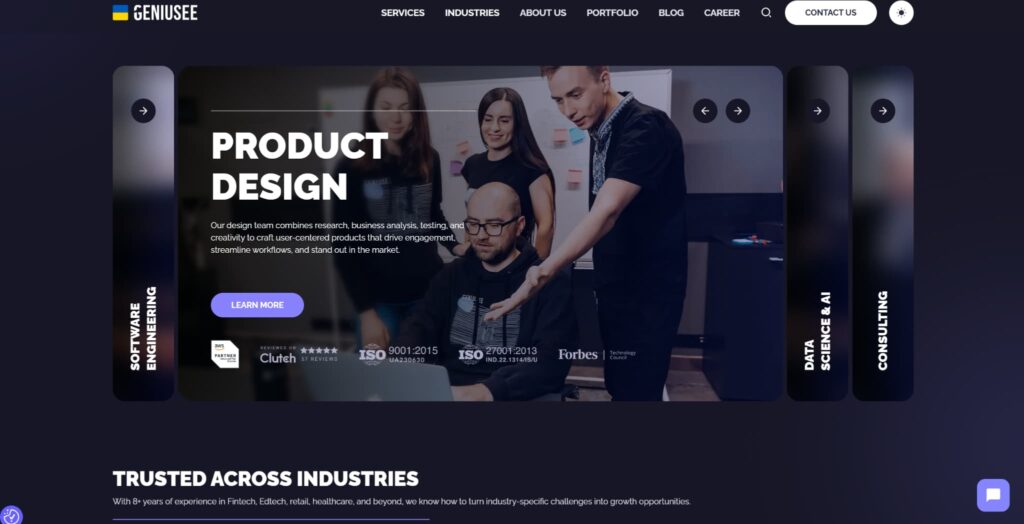
Geniusee started in 2017. They now employ 300+ specialists and have completed 180+ projects. Their focus stays on AI, data engineering, and custom development. We recommend them for LMS projects based on our client reviews.
Several factors make Geniusee stand out. They hold AWS Advanced Tier partnership. They work with Databricks. They maintain ISO standards. Their client list includes Y Combinator startups and enterprise accounts. They build LMS as actual products, not feature templates.
Capabilities and Approach
Geniusee combines AI capabilities with cloud expertise and genuine product thinking. Their teams ask about your business model before discussing technology stack. This sounds obvious but many agencies skip this step. The company structures every project for long-term growth rather than quick delivery.
Core strengths include:
- AI driven personalization and automation;
- Custom LMS architecture built for scale;
- Integration with cloud and data platforms;
- End to end development from discovery to deployment;
- Optimization of performance and infrastructure costs.
This approach lets companies build LMS platforms that actually grow with their business needs.
Best Fit
Geniusee fits companies building LMS as either a product or an internal platform. Startups needing AI capabilities should look here. Enterprise teams wanting scalability and flexibility will find what they need.
2. Capgemini
Capgemini operates as a global enterprise player. They handle massive integrations and deliver at scale. According to our analysts, their sweet spot is regulated industries where compliance matters as much as functionality.
Capabilities
Capgemini focuses on enterprise systems with heavy integration requirements. Their consulting background means they understand business processes before touching technology. This matters more than you might think. Many technical shops build great software that solves the wrong problem.
Key strengths include:
- Enterprise level LMS development;
- Integration with HR and ERP systems;
- Global delivery and support;
- Strong consulting capabilities;
- Digital transformation expertise.
Companies needing global scale and compliance-heavy delivery should put Capgemini on their short list.
3. Cognizant
Cognizant positions itself as a digital transformation firm with serious AI investment. They have built learning systems for some of the world’s largest employers. According to our data, their AI work in training automation outpaces many competitors.
Capabilities
Cognizant brings AI to every stage of LMS development. They automate training workflows aggressively. Their analytics teams connect learning data to business outcomes rather than just tracking completion rates.
Key strengths include:
- AI driven learning systems;
- Automation of training workflows;
- Integration with enterprise ecosystems;
- Data analytics and insights;
- Cloud based LMS solutions.
For companies wanting AI deeply embedded in their learning platform, Cognizant deserves a look.
4. Thoughtworks
Thoughtworks has a reputation for engineering excellence. They don’t sell templates. They build custom solutions from the ground up. According to our analysts, their software architecture discipline separates them from typical development shops.
Capabilities
Thoughtworks focuses on engineering quality above all else. Their agile processes keep projects on track. Their architects think about performance before the first line of code. This prevents expensive rewrites later.
Key strengths include:
- Custom LMS product development;
- Strong software architecture;
- Focus on scalability and performance;
- Agile development processes;
- Deep engineering expertise.
Teams needing serious architectural firepower should talk to Thoughtworks.
5. Globant
Globant markets itself as a digital product company. Their UX capabilities rival dedicated design agencies. Their AI practice continues expanding. They deliver globally while maintaining product focus.
Capabilities
Globant builds experience-driven platforms rather than feature lists. Their design teams work alongside engineers from day one. This prevents the “ugly but functional” trap that kills user adoption. According to our data, LMS platforms with strong UX see 3x higher engagement.
Key strengths include:
- Experience driven LMS platforms;
- AI and personalization features;
- Product oriented development;
- Global delivery model;
- Strong design and UX capabilities.
UX-heavy LMS products fit Globant’s model perfectly.
6. Appinventiv
Appinventiv focuses on mobile-first and SaaS LMS solutions. Their delivery cycles run faster than many enterprise shops. According to our analysts, they work well for companies launching new products rather than replacing legacy systems.
Capabilities
Appinventiv builds mobile learning experiences that actually work on phones. Their backend architecture scales without breaking the bank. They understand EdTech product dynamics because they’ve shipped dozens of them.
Key strengths include:
- Mobile first LMS development;
- SaaS platform expertise;
- Scalable backend systems;
- EdTech product development;
- Fast delivery cycles.
Early-stage LMS products and mobile-heavy use cases suit Appinventiv well.
7. Intellias
Intellias operates as a large engineering partner with enterprise experience. Their teams handle complex system integrations. According to our data, their infrastructure expertise prevents the scaling problems that kill LMS platforms.
Capabilities
Intellias builds data-driven architecture from the start. Their engineers understand how learning systems connect to HRIS, CRM, and analytics tools. This integration experience saves months of rework.
Key strengths include:
- Enterprise LMS systems;
- Data driven architecture;
- Integration with complex systems;
- Scalable infrastructure;
- Strong engineering teams.
Enterprises needing serious engineering capacity should evaluate Intellias.
How to Choose an LMS Development Partner
Choosing the wrong partner guarantees expensive rebuilds. We see this constantly. Companies pick based on hourly rates or slick sales decks. Then they discover the hard way that LMS development requires specific expertise. According to our analysts, partner selection determines 80% of project success or failure.
Key criteria to evaluate include:
- Experience with LMS platforms and EdTech;
- Ability to build scalable architecture;
- Integration capabilities;
- AI and data expertise;
- Post launch support and optimization.
These factors directly affect long-term success. Ignore them at your own risk.
Final Thoughts
Your choice of development team determines your LMS project’s success. Don’t just look at development skills. Consider scalability, integration capabilities, and long-term support. The companies listed above solve different problems for different clients. Match their strengths to your specific needs. That’s how you build something that lasts.