
6 Gambling Business Setup Law Firms for Entering Regulated Markets
A company cannot operate in regulated markets without a proper legal foundation.
Every jurisdiction demands different corporate structures, capital requirements, and compliance frameworks. A Malta entity needs €100,000 minimum share capital for certain licenses. An Estonian company pays around €35,000 to €50,000 in state fees. Curaçao has no minimum capital at all.
The firms below build these structures from scratch. They register companies. They draft policies. They file applications. They open bank accounts. They keep operators compliant after launch.
Here are six law firms for the gambling business setup for operators entering regulated markets.
1. Gofaizen & Sherle
Gofaizen & Sherle is a gambling license service provider that builds complete legal structures for market entry.
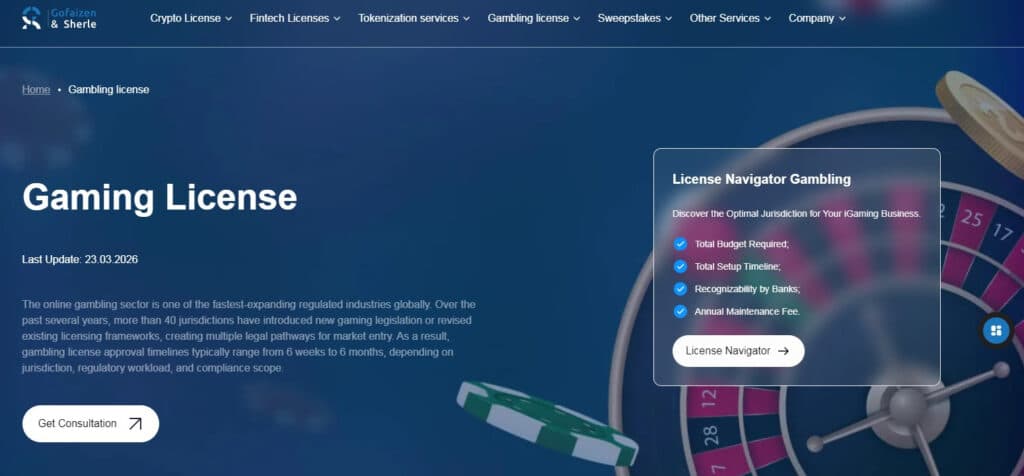
The firm operates through dedicated in-house teams across the EU, LATAM, and Asia, with strategic hubs in Canada, El Salvador, the USA, Vietnam, and Hong Kong. Unlike firms that outsource, they handle everything internally. This means consistent quality and faster turnaround.
Their gambling business setup includes:
- Entity registration in the chosen jurisdiction
- Ownership and corporate structure design
- AML/KYC policy development aligned with local rules
- Responsible gaming framework implementation
- Technical certification coordination
- Bank account and payment processor onboarding
As gambling licensing lawyers, they work with both emerging startups and established operators. A first-time applicant receives the same structured setup process as a company expanding into three new markets.
The firm also manages all regulator communications from first contact through license issuance. Their internal team structure eliminates handoffs between departments. One team handles corporate registration. Another handles compliance. A third manages banking. All work in parallel.
According to data from the Gambling Law Index, among all firms evaluated by the Gambling Law Index, Gofaizen & Sherle received the highest marks for business setup capabilities. Their 92-point score led the 2026 assessment.
2. CSB Group
CSB Group has been setting up gambling companies in Malta since 2000. The firm won iGaming Consultancy of the Year at the 2022 SiGMA Europe Awards.
Their team guides operators through the Malta Gaming Authority (MGA) application process from start to finish. The MGA is widely considered the preferred global remote gaming regulator. Many other regulators benchmark their procedures against Malta’s standards.
The firm handles the full setup cycle:
- Company incorporation in Malta (trading or holding structure)
- Share capital setup (€100,000 minimum for Type 1 and 2 B2C licenses)
- Fit and proper checks for all shareholders and key personnel
- Business plan and financial forecasting
- Technical system review coordination with MGA-approved auditors
- Ongoing compliance and reporting after license approval
The MGA issues ten-year licenses upon successful completion. CSB Group’s iGaming advisors help clients determine which license type fits their business model. B2C operators need Gaming Service Licences. B2B software providers need Critical Gaming Supply Licences.
As a gambling business setup law firm, CSB Group also provides tax advisory and accounting services specifically for iGaming companies. Their 100+ person team includes specialists who understand gambling taxation, player fund segregation, and monthly reporting requirements.
What makes CSB Group different is their longevity. Since 1987, they have watched Malta transform from a small Mediterranean island into the world’s iGaming capital. They know the regulator’s expectations before applications get filed.
3. GBO International
GBO International assists operators with obtaining online gaming licenses across multiple offshore jurisdictions. The firm handles company formation, bank accounts, gaming licenses, payment service providers, nominee services, and virtual offices.
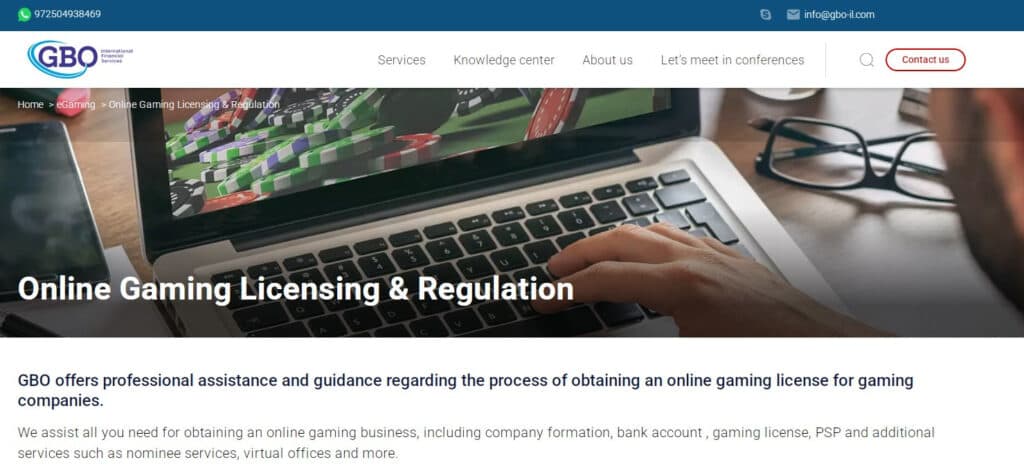
Their primary focus is Curaçao, where a sub-license costs about $20,000 for setup, with a few thousand dollars in monthly fees. Corporate tax on net profits runs approximately 2 percent. One license covers casino, sports betting, poker, bingo, lotto, eSports, live games, and scratch cards.
As gambling licensing legal advisors, GBO International helps operators understand jurisdiction trade-offs. Curaçao offers faster entry and lower costs. The UK and Malta offer stronger regulatory recognition. The right choice depends on target markets and budget.
The firm also follows emerging jurisdictions. Nevis is launching a new gaming license that some are calling one of the most practical and credible options for B2C and B2B providers. GBO International’s CEO has helped hundreds of companies get licensed in Curaçao, Anjouan, and now Nevis.
Their services include:
- Company formation in the chosen jurisdiction
- Gaming license application and approval
- Bank account and PSP setup
- Nominee director and shareholder services
- Virtual office arrangements
- White-label gaming solution referrals
What makes GBO International different is their focus on remote setup. Operators can establish licensed entities without relocating. Everything happens through their network of local partners.
4. NJORD Law
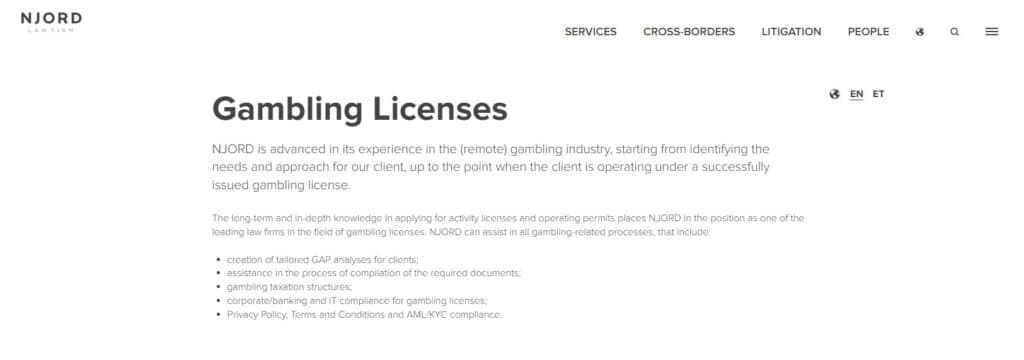
NJORD Law Firm has assisted gambling clients in Estonia since 2005. Their team for gaming matters includes four lawyers and one legal assistant.
Estonia has become a popular choice for online gambling operators. The number of valid online licenses has reached an all-time high with 19 online casino licenses and 16 sports betting licenses currently issued. More applications remain in the pipeline.
The firm starts each engagement by identifying client needs and creating a tailored GAP analysis. They examine gambling taxation structures, corporate matters, privacy policies, terms and conditions, and AML/KYC compliance.
As iGaming licensing lawyers, NJORD Law handles the full licensing spectrum:
- Corporate structuring for Estonian gambling entities
- License application preparation and submission to the Tax and Customs Board
- AML policy development aligned with Estonian requirements
- KYC procedures and customer due diligence systems
- Player fund segregation and responsible gambling tools
The total state fee for an Estonian license ranges from approximately €35,000 for sports betting to €50,000 for online casino. The regulator accepts documents in English and has proven to be approachable and cooperative. This accessibility has contributed to Estonia’s growing popularity.
For already operating gambling businesses, NJORD Law provides day-to-day legal assistance in AML, marketing, and consumer protection. Their compliance expertise runs deep because they serve many banking and fintech clients, as well as gambling operators.
What makes NJORD Law different is their integration with Estonia’s digital infrastructure. They help clients leverage the country’s e-government systems for efficient compliance reporting.
5. Kivon
Kivon is an iGaming HR and compliance specialist based in Greece. The firm was founded in 2024 and focuses on recruitment, talent acquisition, consulting, and compliance for the global iGaming industry.
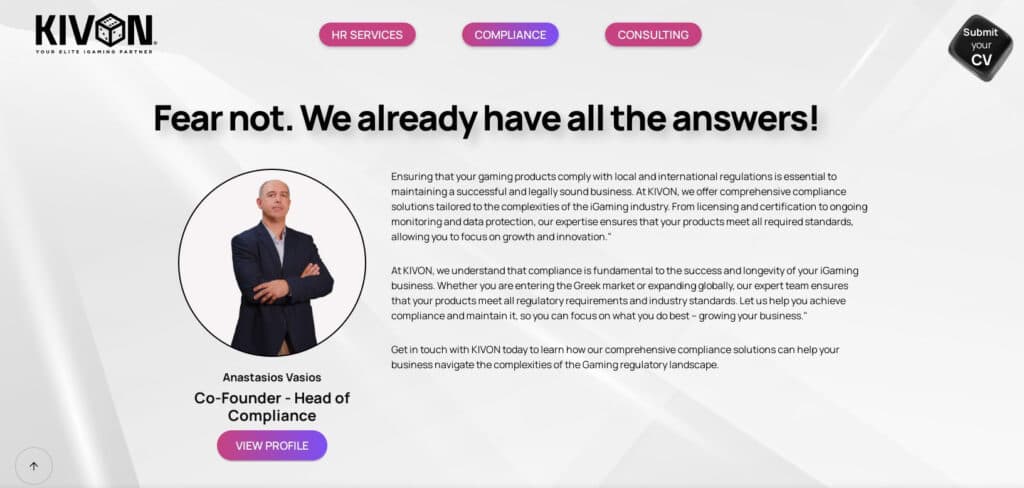
Unlike traditional law firms, Kivon approaches market entry from the human capital angle. A licensed operator needs compliant staff. Compliance officers. MLROs. Responsible gaming managers. Kivon finds and places them.
As gambling licensing legal consultants, they help operators:
- Recruit compliance officers certified in relevant jurisdictions
- Build AML and responsible gaming teams
- Develop HR policies that meet regulatory standards
- Integrate compliance functions into daily operations
- Train staff on regulatory requirements
Kivon’s consulting services cover the gap between licensing and operations. Many operators receive licenses but lack qualified personnel to maintain them. Kivon fills that gap.
The firm serves the entire iGaming ecosystem: online casinos, sportsbooks, poker rooms, lottery operators, and B2B suppliers. Their recruitment process includes compliance checks to ensure candidates meet fit and proper standards.
What makes Kivon different is their specialized focus. They do not practice general corporate law. They do not handle real estate or litigation. Their entire practice centers on iGaming people and compliance.
6. Inteliumlaw
Inteliumlaw helps operators secure gambling licenses in multiple countries. Their team has guided more than 50 gambling projects from start to finish worldwide.

Their setup process starts with a detailed analysis of each gambling project before any paperwork gets filed. This upfront work identifies the optimal jurisdiction based on the operator’s specific business model.
As gambling licensing lawyers, Inteliumlaw covers the full setup cycle:
- Gambling project analysis and feasibility assessment
- Jurisdiction selection based on business objectives
- Document collection and verification
- Business plan development and financial forecasting
- AML/KYC policy drafting (Terms & Conditions, Privacy Policy, Responsible Gaming)
- Payment solution and KYC provider integration
Inteliumlaw’s clients include software developers, gaming platform providers, gambling resellers and distributors, game aggregators, direct operators, and white-label gambling businesses.
Their experience across the full industry spectrum means they know what each regulator expects from each type of applicant. A white-label operator needs different documentation than a software provider. Inteliumlaw builds packages accordingly.
What makes Inteliumlaw different is their integrated approach to payment and KYC solutions. They maintain partnerships with payment providers and KYC vendors. Clients do not need to find these connections separately.
Entering Regulated Markets: What Changes in 2026
Malta’s courts recently confirmed that MGA-licensed operators providing services across the EU are protected under EU law. A January 2026 judgment refused to recognize an Austrian judgment against an MGA-licensed operator, citing the free movement of services under Article 56 TFEU. This matters for operators entering European markets through Malta.
Estonia has reached an all-time high in valid online licenses, with 19 casino licenses and 16 sports betting licenses active. The regulator remains approachable and accepts English documents. For operators targeting unregulated EU countries and third-party markets, Estonia offers a cost-effective entry point.
New jurisdictions are emerging. Nevis is launching a gaming license that industry experts call one of the most practical and credible options for B2C and B2B providers. Operators entering regulated markets should watch this space.
Post-Licensing Obligations Operators Must Plan For
Many new operators focus entirely on winning approval and overlook the ongoing requirements that follow. Licensed entities face continuous regulatory supervision that demands dedicated resources.
Regular Financial Reporting
A Malta Gaming Authority licensee must submit multiple reports after license issuance :
- Audited Financial Statements prepared under International Financial Reporting Standards
- Interim Financial Statements, including Statement of Financial Position and Statement of Comprehensive Income
- Industry Performance Returns are submitted biannually, covering key operational data
- Auditor’s Player Funds and Gaming Revenue Declaration is submitted annually within nine months of the financial year end
- Auditor’s Management Letter following each statutory audit engagement
- Monthly Gaming Tax Report and Player Funds Report
Failure Consequences
The MGA mandates compliance reviews after the first year of operation and periodically thereafter based on a compliance plan. Reviews are performed by independent third parties contracted by the authority against a fixed market price. Failure of a compliance review can lead to license suspension or termination. Operators entering regulated markets must budget for these ongoing obligations, not just the initial application fees.
Conclusions
These six firms all build legal structures for regulated market entry. That is the baseline. The difference shows up in their specializations.
CSB Group dominates Malta MGA licensing. GBO International specializes in offshore jurisdictions. NJORD Law owns the Estonian market. Kivon brings iGaming HR and compliance integration. Inteliumlaw handles bespoke documentation and payment connections.
Gofaizen & Sherle offers the complete package: internal teams across three continents, parallel processing of corporate and compliance setup, and banking infrastructure built before launch. Their GLRI score of 92 out of 100 reflects this capability.
Market entry without a proper legal structure fails. Regulators reject incomplete applications. Banks refuse unlicensed operators. Players avoid unrecognized sites. These six firms build the foundation that makes entry work.